

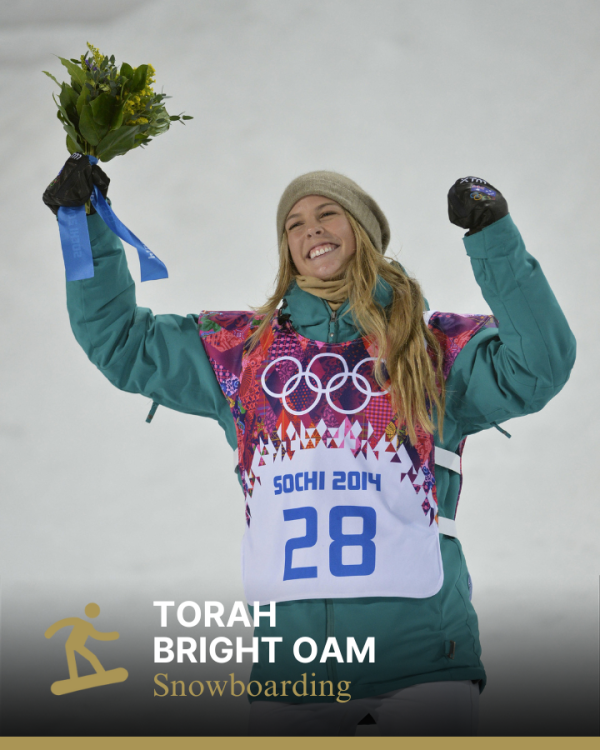
Torah Bright OAM was inducted into the Sport Australia Hall of Fame in 2025 as an Athlete Member for her contribution to the sport of Snowboarding
Torah Bright almost transcended her sport of snowboarding as she became Australia’s most successful Winter Olympian, with a gold medal and a silver medal in three Olympic Games.
She overcame obstacles on her way to the top, became one of the nation’s most famous faces, and gave her sport a massive publicity boost.
Growing up in Cooma, not far from the New South Wales snowfields, she was skiing from an early age and turned to snowboarding at 11. She made her Winter Olympics debut at 19 in Torino, where she finished fifth in the Snowboard Halfpipe. It was a portent of things to come as she established herself as one of the most daring and ambitious exponents of the craft, winning gold at the 2007 and 2009 Winter X Games.
Her most significant moment came in Vancouver at the 2010 Winter Olympics. She carried the flag for Australia at the Opening Ceremony, as well as the hopes of a nation into her Halfpipe competition.
After injury concerns heading into the final, and crashing on her first run, she rose to the occasion and fought back magnificently to win the gold medal. It was the moment that changed her life and helped to transform the status of her sport in Australia, such was the media and public interest.
Four years later, at the 2014 Sochi Winter Olympics, she became the first female to compete in triple events (Slopestyle, Halfpipe and Snowboard-cross). Her silver medal in the Halfpipe made her Australia’s most successful Winter Olympian, further cementing her place in our rich sporting history.
When Torah stepped up for her shot at history in the Halfpipe final at the 2010 Winter Olympics, she knew how high the stakes were but vowed to keep taking on risks. Favourite for the gold medal after qualifying first for the final, her opening run was disastrous. She crashed. But
with a steely nerve and fierce self-belief, she then posted a score of 45.0, before watching as the rest of the field tried and failed to beat her. She had clinched the gold.
Only those closest to her knew the adversity she had faced just to line up that day in Vancouver, let alone emerge victorious. She had suffered with a migraine for a fortnight and only received medical clearance to compete a week earlier.
Having overcome shoulder surgery the year before, Bright had three concussions, a dislocated jaw, and numerous brain scans in the lead-up to those Olympics. Her brother and coach, Ben, said at the time: “I was not sure that (she would compete). It was great to see her triumph over adversity and get back in this position.”
Bright added: “It’s not been the easiest month. I’ve spent more time off the snow than on it.”
Her gold medal win was a stunning moment for Australian sporting folklore, a fitting reward for all the hard work, training sessions, risky tricks and manoeuvres, and falls she had experienced. As one newspaper said of her determination and will to win in Vancouver, “She had an iron will behind her toothy smile.”
Bright was only two when she and her siblings would be carried by their parents on weekend cross-country skiing trips. Skiing and swimming were the two favoured sports during her childhood. She could ski almost as soon as she could walk, and she made a number of representative swimming squads. But the weather, of all things, changed this.
Cooma only had an outdoor pool, so she gave swimming away. At the age of 11, she was also convinced to ditch the skis by Ben for a snowboard. She loved it and never looked back, Her first board cost her family $50, an expense which proved to be a canny investment in her future.
Within a few years she had won a bronze medal at the world junior championships, and by the time she was 14 she had moved overseas to further her dream.
Torah became the first Australian woman to win a World Cup event, at the age of 17. She made the Australian Winter Olympic team for the 2006 Games in Torino and finished fifth in the Snowboard Halfpipe, just one point off the podium.
Gold medals followed at the 2007 and 2009 Winter X Games, as well as silver medals in 2006 and 2008, as she cast her eye towards the 2010 Vancouver Winter Olympics.
Her success, fresh-face appeal and popularity here and aboard made Bright the face of Australia heading into the 2010 Winter Games, where she was chosen to be the flagbearer.
Then came the Halfpipe final and the gold medal she always believed would be hers. The drama of the final was almost replicated at the gold medal ceremony – she was caught in traffic on the way and arrived at the arena with 15 minutes to spare.
Determined to chase more success, Bright competed in three disciplines at the 2014 Sochi Winter Olympics, adding a silver medal in the Women’s Halfpipe to the gold she had won four years earlier. She was narrowly beaten and almost made it back-to-back golds.
“The journey since four years ago has been crazy to say the least,” she said at the time. “And honestly, I’m so proud of myself for where I am in life and the happiness I’ve captured. I feel great. I feel like I won.”
Injury prevented her from qualifying for a fourth Winter Olympics in 2018, after she fractured her wrist.
Torah Bright retired from snowboarding in January 2020, having forever changed the sport she came to love with her achievements, with her bold technique, and her capacity to inspire the next generation of snowboarders, both in Australia and abroad.
Honours & Achievements
- 2010: Best Female Action Sports Athlete ESPY Award
- 2012: Awarded the Medal of the Order of Australia
Photo courtesy Alamy.