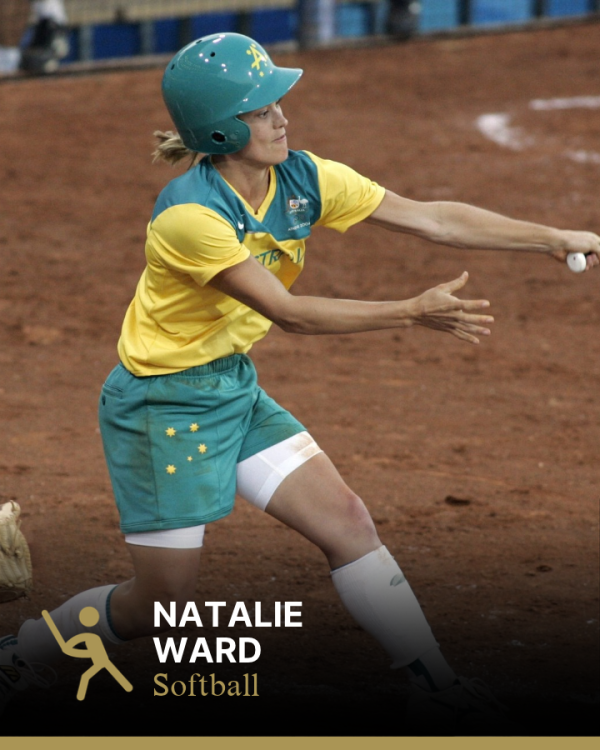
Natalie Ward was inducted into the Sport Australia Hall of Fame in 2026 as an Athlete Member for her contribution to Softball.
Natalie Ward was one of Australian softball’s most decorated and greatest players, highlighted by the rare distinction of winning medals at four separate Olympic Games.
In a career which saw her graduate from a talented teenager with boundless potential into a steady-handed national captain capable of performing under acute pressure, Ward fashioned herself as one of the world’s best infield players.
She helped to guide the Australian team through its most successful era, was a resilient and reliable performer across a decade and a half, and was a role model and inspiration for the next generation of stars coming through the ranks.
Ward was a member of the national side from 1994 to 2008, with her softball career almost aligning perfectly with four Olympic Games, including a home Games in 2000.
She was a member of the silver-medal winning team at the 2004 Olympics – which she rated as one of her career-highlights – while she also earned three bronze medals at the 1996, 2000 and 2008 Games.
She also represented her country consistently at world championships, driving high-end results as the ‘Aussie Spirit’ took on – and sometimes beat – the world’s best.
She also captained the team from 2005 until her retirement in 2008,
Ward was the first Australian softballer to play 400 games for her country, having surpassed Sally McCreedy’s record of 357 games in 2006.
She bowed out after the 2008 Beijing Olympics, holding the Australian record of 429 games for 13 years until Stacey Porter overtook her tally in 2019.
Ward’s impact was further acknowledged when she was inducted into the Australian and International Softball Halls of Fame, stamping her status as one of softball’s greatest stars.
Natalie Ward always had an impeccable sense of timing on and off the softball field.
On the field, one of her coaches described the short-stop, sometimes second base player and powerful hitter as “one of the best players I’ve seen in tight situations … she (would often) make the key play or get that final hit to get Australia over the line.”
Fabian Barlow, who was the national coach late in Ward’s softball career, described how she always had the team at the forefront of her thoughts, saying that she “rises to the pressures of the games (when the team most needed her).”
Off the field, she was selfless and intent on getting the best out of herself with the team being the beneficiary of her endeavours.
In keeping with her exquisite timing, Ward’s international softball career couldn’t have come at a more opportune time.
Her 14-year run on the world stage paralleled softball’s rise to Olympic status.
Ward was a four-time Olympian, and along with ‘Aussie Spirit’ teammates Tanya Harding and Melanie Roche, were the first Australian female athletes to win medals at four successive Olympic Games.
But her career would almost certainly have been longer – maybe even with more medals – if the sport had not been controversially sidelined following the Beijing Olympics.
Ward would say after her 2008 retirement that she “came into softball at the perfect time … it was a huge slab of my life.”
“I feel so proud that we have won four medals at the Olympic Games. Not many people can say they have achieved that … I feel extremely lucky to have done what I’ve done.”
Her timing might have been fortuitous, but her team and individual triumphs were built off hard work, a fierce determination, a strong tactical acumen, a leadership mindset to strive to get better as an individual and team member, and a resilience to overcome numerous injury challenges.
Her speed, her innate sense of anticipation and her mastery of the game helped her become the first Australian softballer to play 400 games, taking her tally to a record 429 games before her retirement in 2008.
She held the record for 13 years before Stacey Porter surpassed it in 2019.
But Ward was never fixed on counting the games; instead she counted the moments.
As she explained after breaking Sally McCreedy’s 356-game record in 2006: “It makes me proud to be able to represent my country at the highest level, but I don’t see it about the number of games I’ve played, but the opportunities I’ve had in the game that I love.”
She fell in love with the sport, hitting softballs in the backyard of her family’s home in Kotara, a suburb of Newcastle, before starting to play competitively as a 10-year-old, following in the footsteps of her older sister Linda.
She was still 18, and a fresh-faced talent, when she was first selected for Australia in a test series against Japan, and from that moment on, she never looked back.
Ward swiftly established herself as one of the national team’s mainstays, with her defensive infield prowess as a short-stop and at times second base making an immediate impression.
She played in her world championships that season and within two years she had become a key member of the Australian team as softball made its debut as an Olympic sport in 1996, calling herself “the baby of the group”.
In a seismic moment for the sport, the Australians defeated the powerful United States team 2-1 in an extra innings during a preliminary match during those Olympics, which would be one of her career highlights.
As she recalled: “When we hit the ball over in the extra innings it was deafeningly silent from the US … all you could hear was the 80 Aussie fans going wild in the stands.”
The United States ultimately won that first Olympic softball gold medal, but the Australians – and Ward – secured a bronze medal consolation.
“Atlanta in 1996 was the first Olympics for softball and we medalled there, and I was only 20 and it was just an amazing experience for me,” Ward would say later.
She had cemented herself as one of the sport’s most recognisable faces – and one of its best players – in the lead-up to a home Olympics in Sydney four years later.
The crowds were enormous and the pressure intense on home soil, with Ward saying the roar just before walking into the Sydney Olympic Stadium for the Opening Ceremony was “like a jumbo jet … the noise and the excitement of the group as we waited to come out onto the ground … it is the fastest 400 metres I have ever walked.”
But while the Australians again defeated the United States in the preliminaries, the tables would be turned in a final that sent the visitors into a gold medal playoff and the home side winning another bronze medal.
Ward and the ‘Aussie Spirit’ went a step further at the 2004 Athens Olympics, defeating Japan 3-0 in the final to set up a gold medal playoff against the United States. But the Americans were too strong, winning 5-1, with the Australians disappointed but still proud to be bringing a silver medal home.
Ward made no secret of the fact she was driven by a different coloured medal – a gold one – leading into the 2008 Olympic campaign.
She knew Beijing would be her last Olympics, given softball had already been excluded from the London Games.
The one-time teenager who shone on her Olympic debut at Atlanta was now almost 33 and in her fourth Games she was chosen as one of the veterans standing in the front row at the Opening Ceremony, a moment that meant so much to her.
But the fairytale wasn’t to be.
The Australians lost to Japan in what turned out to be a marathon preliminary final, in an agonisingly close 4-3 loss.
The scores had been deadlocked at 2-2 at the end of the seven innings, before Japan finally broke the deadlock five innings later.
It was a fourth Olympic medal for Ward, albeit a bronze and not the gold medal she wanted.
“That is it for me,” she said after the game. “It was not the fairytale ending I had hoped for, but I am still proud of the girls.”
“I only wish I brought home a different colour (medal).”
Ward’s enduring legacy might be every bit as important as her impact on the field. She was a role model and inspiration for young girls, and in the years since, has used her talents to help mentor and guide future stars of the sport.
Honours & Achievements
- 1994: Named in the international All Star team following the Canada Cup
- 2005: Appointed captain of the Australian national team, a role she held until her retirement in 2008
- 2006: Broke Sally McCreedy’s record for the most games played for Australia
- 2008: Retired as the first Australian softballer to play 400 games for her country, setting a national record of 429 games that stood for 13 years
- 2012: Inducted into the Softball Australia Hall of Fame
- 2017: Inducted into the World Baseball Softball Confederation Softball Hall of Fame
- 2026: Inducted into the Sport Australia Hall of Fame
Photo courtesy Newspix.


