

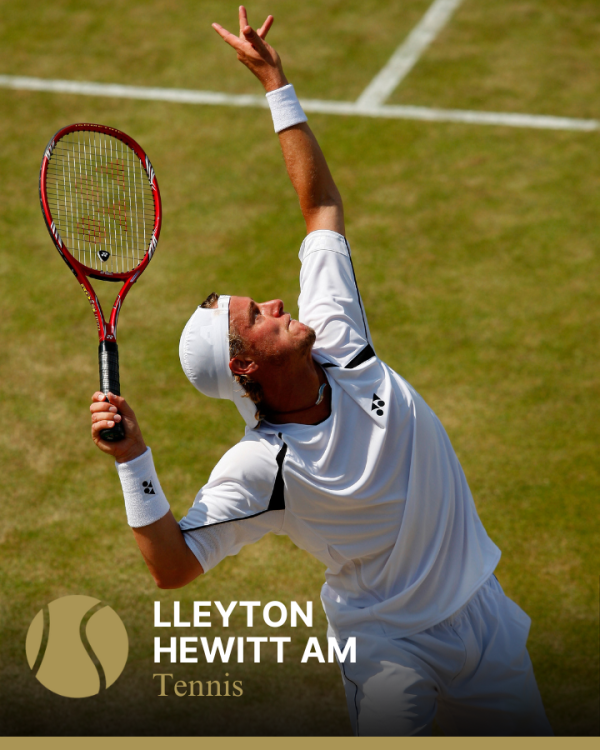
Lleyton Hewitt AM was inducted into the Sport Australia Hall of Fame in 2025 as an Athlete Member for his contribution to the sport of Tennis
Lleyton Hewitt’s extraordinary ride from tennis wunderkind to the world’s No.1 ranked player became one of Australian sport’s most compelling success stories.
Carrying on the rich traditions of past Australian tennis greats, though with a very modern twist, Hewitt realised his childhood dreams by winning two grand slam singles titles in a career spanning two decades.
His first major title came at the 2001 US Open when he defeated one of the modern greats, Pete Sampras. His second came at Wimbledon in 2002 as he overcame David Nalbandian.
He was also runner-up at the 2004 US Open and the 2005 Australian Open.
Hewitt won two ATP Tour finals in 2001 and 2002, was an instrumental force in Davis Cup triumphs for Australia (1999, 2003) and claimed 30 singles titles as well as three doubles titles.
He became the youngest male world No.1 player, at 20 years and 268 days – in November 2001. It was a record that lasted until 19-year-old Carlos Alcaraz surpassed it in 2022.
Hewitt was ranked world No.1 for 80 weeks, 75 in a row, with his durability and resilience evidenced by the fact he played in a record 20 consecutive Australian Opens.
He was made a Member of the Order of Australia (AM) in 2016, and was elevated to the International Tennis Hall of Fame in 2022 and the Australian Tennis Hall of Fame in 2024.
When Hewitt was asked by the media what characteristic set him apart from many of his contemporaries when he was elevated to the International Tennis Hall of Fame, he summed it up in one word: “Competitor”.
It sounded like the perfect answer. For all the talent and skill Hewitt crafted and perfected long before he stepped out of the shadows into stardom, for all the exquisite passing shots, rundowns and pinpoint returns of serve, it was his dogged determination and refusal to concede which proved his competitive lifeblood.
As he told the Associated Press at the time, he thrived on the scent of battle: “For me, someone that loved to lay it on the line day after day, and got the most out of themselves, I competed as hard as I possibly could on the court every time I took to the court.”
That will to win against the odds, that ultimate belief, drove Hewitt on to become a champion.
His pedigree was a sporting one, with father Glynn a former VFL and SANFL player and his mother Cherilyn a netballer and physical education teacher.
But tennis was Lleyton’s Hewitt’s destiny, and he worked at it tirelessly from a very early age. At five he attended his first Australian Open, and a year later watched bleary-eyed as Pat Cash won Wimbledon in 1987, dreaming of one day emulating that feat. He was 15, a month short of his 16th birthday, when he qualified for his first Australian Open in 1997, the youngest qualifier in more than a century of the famous tournament.
It began 20 consecutive Australian Open appearances, with Hewitt saying: “I always dreamt of playing here once … to end up playing 20 years in a row (was incredible).”
A year later, at 16 and ranked 550 in the world, he went into his hometown Adelaide Masters first round in 1998, hoping to take a game off Scott Draper. He did more than that – he won and went on a roll to make a semi-final against superstar Andre Agassi.
With his blond locks and soon-to-be trademark backwards facing cap, Hewitt caused one of the biggest boilovers in tennis, overcoming a stunned Agassi in straight sets 7-6, 7-6. The Year 11 student at Adelaide’s Immanuel College went on to win that tournament – his maiden ATP tour title and the first of 30 in his career –, by coming from a set down to defeat Jason Stoltenberg.
It was the kick-start of an extraordinary career, with his biggest moments coming in grand slams and at Davis Cup level, where his passion for representing his country shone.
At just 19 years old, Hewitt captured his first Grand Slam title by winning the men’s doubles at the 2000 US Open alongside Max Mirnyi. He remains the youngest male player in the Open Era to achieve a Grand Slam doubles victory.
He won his first grand slam singles title at the US Open in 2001, a year after winning the doubles title at the same tournament, defeating Pete Sampras in straight sets 7-6, 6-1, 6-1 in a statement-making performance just two days before the September 11 terror attacks.
After getting a pre-match rev-up from past winner Pat Rafter, Hewitt delivered a masterful performance that even surprised him, saying afterwards: “It hadn’t really sunk in that I was that far ahead. I was still taking it one point at a time, one game at a time.”
Within two months Hewitt was crowned world No.1, the youngest player ever at the time. He ended 2001 year with the ATP Final victory as well.
Hewitt was unquestionably the world’s best male player when he won Wimbledon in 2002, a baseliner who could also excel on grass, closing out the final against David Nalbandian in straight sets and dropping only two sets in the tournament.
He explained: “It’s what kids dream of, sitting back at home watching Pat Cash at Wimbledon 15 years ago. It’s what every Australian kid who picks up a tennis racquet dreams of, to one day be in this situation.”
In the same year, he won a second ATP finals victory, making it back-to-back success.
Having had the edge on Roger Federer in their rivalry’s infancy, it sharply swung back the other way when the Swiss ace stood between Hewitt and a second US Open title in 2004. Then in 2005, he fell just short of an Australian Open triumph, losing to Marat Safin in the final. Turning the tables once again later in his career wining the finals at Halle and Brisbane against Federer.
Hewitt’s reign as the world’s No.1 player tucked in between greats such as Sampras and Agassi at one end and the royal triumvirate of Federer, Rafael Nadal and Novak Djokovic at the other.
His feisty on-court behaviour, his fist-pumping “C’mon!” roar and his aggressive approach to the game and sometimes to officialdom didn’t always endear him to everyone, but no one could ever question his passion or his fighting spirit.
While Hewitt never medalled at the Olympics, he proudly represented Australia three times in 2000, 2008 and 2012, facing some of the top players in the world.
His Olympic career reflected his longevity and commitment to national representation across both Davis Cup and the Games.
His desire to represent Australia was almost a throwback to the great Davis Cup players of another age. He played a key role in two Davis Cup victories, as an 18-year-old in 1999 and then in 2003.
“Wherever I have played around the world, every time I step on the court, I’ve done so as a proud Australian,” Hewitt explained.
So much so that when his playing career ended, Lleyton Hewitt took on the esteemed role of Australia’s Davis Cup captain.
Honours & Achievements
- 2001 & 2002: ATP Player of the Year
- 2003: Young Australian of the Year
- 2011: Newcombe Medal – Spirit of Tennis Award
- 2013: Newcombe Medal – Most Outstanding Australian Player
- 2016: Made a Member of the Order of Australia
- 2022: Inducted into the International Tennis Hall of Fame
- 2024: Inducted into the Australian Tennis Hall of Fame
Photo courtesy Alamy.


