


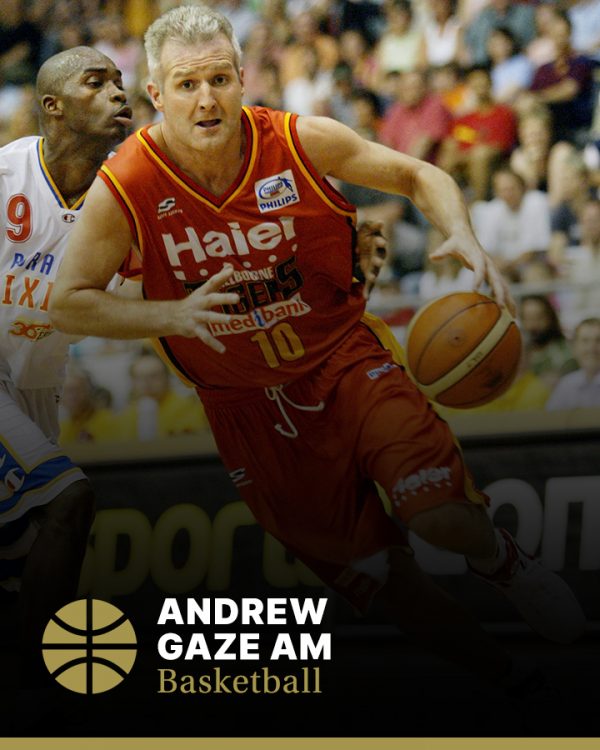
Andrew Gaze AM was inducted into the Sport Australia Hall of Fame as an Athlete Member in 2005 and was elevated to Legend status on August 25, 2025 for his contribution to the sport of Basketball.
Andrew Gaze literally towered over the sport as one of Australia’s greatest basketballers in a stunning career that almost seemed his destiny from a young age.
The son of legendary coach Lindsay Gaze, he played a significant role in the growth of the game in this country, with his impact almost immeasurable on and off the court. His dynamic game sense, pinpoint accuracy in nailing shots, especially from the arc, and inspirational leadership swiftly elevated him into the top echelon of the game.
Gaze helped to shape the direction of basketball in a 22-season career with Melbourne Tigers in the National Basketball League, in representing and leading Australia on the international stage, and later as an NBL coach and leading media commentator.
He played more than 600 NBL games, scored almost 19,000 points at an average of 30 points per match, and helped the Tigers to two championships (1993, 1997). Gaze won the NBL’s Most Valuable Player award a record seven times (1991-92, 1994-98), an indication of his status within the fiercely competitive domestic competition.
He was considered by many to be the greatest player in NBL history, he still holds a swag of records, and his international performances elevated his status even further.
Gaze rode the wave in the US with Seton Hall University all the way through to the NCAA Championship Game in 1989, and had two stints in the National Basketball Association, playing with the Washington Bullets and San Antonio Spurs. He was on the roster when the Spurs won the NBA title in 1998-99, and he also played professionally in Greece and Italy.
But it was the stellar performances with the Australian Boomers that defined his greatness, including five Olympic Games (1984, 1988, 1992, 1996, 2000), 297 games in the green and gold, and eight years as his nation’s captain. Three times he took the Boomers into bronze medal playoffs, he scored the second most points in Olympic history, and one of his greatest honours came when he was named as Australia’s flagbearer at the Sydney 2000 Games, in his fifth and final Olympic competition.
Gaze was made a member of the Order of Australia in 2002, inducted into the Australian Basketball Hall of Fame in 2004, the Sport Australia Hall of Fame in 2013, and the FIBA Hall of Fame. He was made a legend of the Australian Basketball Hall of Fame in 2022.
Luc Longley knew Andrew Gaze by his code name, “The Factor”, when Gaze was treading the boards as the Boomers’ inspirational captain and one of the team’s game-changing stars. The name was appropriate – he was our longest serving and most important player in five Olympic and four World Cup campaigns.
When Gaze was elevated to legend status of the Australian Basketball Hall of Fame in 2022, Longley spoke glowingly of the impact he had on the national team.
“The Factor – that he was,” Longley said. “As his teammate with the national team, I knew he lived up to the name without fail. His ability to get it done every night and find ways to score when others couldn’t was consistent with greatness.”
In many ways, Longley’s assessment sums up Gaze’s extraordinary career, for he really was the key factor in so much of what made Australian basketball tick for a generation.
He seemed destined to become a basketball great from an early age, as the son of legendary coach Lindsay Gaze, one of the game’s famous pioneers in Australia, first as a player and more successfully as a coach.
Andrew once said he couldn’t remember a day when basketball was not a part of his life, and it gave him the perfect platform growing up in Albert Park. He was playing in the Melbourne Tigers under-12s when he was five, and won the first of his most valuable player awards at a Moomba junior basketball tournament when he was 11.
By the time he was 18, Gaze had been named the National Basketball League’s rookie player of the season, and in that same year, 1984, he was chosen to represent Australia at the Los Angeles Olympics, capping off a meteoric rise.
He and Lindsay, who coached him through more than 600 games for the Tigers, as well as for a portion of his international career, became one of Australian sport’s most beloved double acts.
They were fierce competitors, but they were also modest, humble promoters of the sport.
As NBL Hall of Famer Wayne Carroll said: “The greatest accolade is that Lindsay is now considered Andrew Gaze’s father, whereas the screams of nepotism were once loud and strong. Andrew has just got the greatest feeling for the game we’ve had here.”
Gaze’s basketball career can be seen through different prisms.
There was the prodigy who would be acknowledged as the greatest Australian to play in the NBL and who was still an elite performer when he retired at the age of 39. He was the face of basketball in this country for a generation.
There was also the inspirational Boomers player and captain, who revelled in representing his country in big tournaments, including a record five Olympic Games and four World Cups.
Add to that the achievements of playing professional basketball in the US (two stints in the NBA including being on the roster when the San Antonio Spurs won the 1998-99 title) as well as in Italy and Greece.
As Gaze explained in his acceptance speech when he was elevated to legend status of the Australian Basketball Hall of Fame, joining his father: “I’ve been very fortunate throughout my career to be a part of this great game both here in Australia and on the international stage. To follow in my father’s footsteps is a dream I never dared to imagine. I am eternally indebted and grateful for the opportunities the game has provided me. I am humbled.”
On the home front, Gaze was voted the NBL’s most valuable player on a record seven occasions and also named the competition’s MVP across the league’s first 25 years.
He won two NBL championships with Melbourne Tigers, in 1993 and 1997, with the first title providing Australian sport with one of its most heartwarming moments. In an unforgettable image, Gaze embraced his father, mentor and coach Lindsay, midcourt after the Tigers had defeated the Perth Wildcats in the deciding match.
His NBL career stretched from 1984 to 2005, and he locked away more records than any player could ever hope to attain, some of which remain beacons for future generations aspiring to greatness.
He scored the most points (18,908) in NBL history, and his CV included 14 NBL scoring champion awards as well as 11 NBL All-Star selections. Fittingly, the NBL’s MVP award is named after Gaze.
His dominance on the home front should never detract from what he achieved overseas.
Having been scouted by US talent spotters at the 1988 Olympics, he joined Seton Hall University and helped the Pirates on a wild ride, only to be stopped in a heartbreaking 79-80 overtime loss to Michigan in the 1988-89 NCAA championship final.
He told ESPN years later that such was his disappointment, not just for the controversial call that went against Seton Hall in the dying moments, that he hadn’t watched the full game since. But it was still a moment to cherish, he said: “There was a great sense of achievement, and it was a remarkable opportunity. For an international player at the time, it was a unique experience.”
It was a significant moment that captured the attention of Australians on the other side of the world. It also paved the way for the explosion of Australian basketball hopefuls heading to the US College system into the 21st century.
Gaze had two stints in the NBA, first with the Washington Bullets, but more significantly as part of the roster in the 1998-99 championship-winning San Antonio Spurs.
At the time Spurs coach Greg Popovich said: “Andrew is one of the premier shooters in the world. If our main guys are hurt or need rest, this guy is a good enough player to join right in and get some time on the court.”
While Gaze, then 34, didn’t get a lot of game time in the Spurs’ star-studded lineup, he still played 19 games in the regular season before the team went on to win the title. He wasn’t a part of the Spurs’ finals run but he did win a championship ring.
It was Gaze’s long and distinguished career with the Boomers that showed the world how good he was as a player and a leader.
He played 297 games in green and gold, spread out across five Olympic Games (he is still the second highest all-time scorer with 789 points) and four World Cups. Gaze exuded national pride every time he pulled on the jersey, from his first Olympics as an 18-year-old at the 1984 Los Angeles Games to his fifth and final Games in Sydney in 2000. He played a massive part in helping the Boomers to reach three bronze medal playoffs, but each time the rub of the green went against the Australians, leaving them short.
One of his greatest honours came with selection as Australian’s flag-bearer at the Sydney Olympics, a moment he described as one of the best of his life.
A loss to Lithuania in the bronze medal game in 2000 – the third time in 12 years Gaze and the Boomers came so close to winning an Olympic medal – ended his Olympic career, but he was typically humble with the disappointment so fresh.
Immediately after the game, he said: “I have a sense of gratitude for the opportunities that I have had, and I think there comes a time where it’s up to others to have the opportunity to compete and perhaps take it to another level.”
He was moved to tears on television 21 years later when the 2021 Boomers finally unlocked the Olympic medal puzzle, winning a bronze.
Gaze said on Channel 7: “In 88, 96, 2000 (finishing fourth), they’re beautiful journeys. You don’t have to win a medal to have beautiful journeys. It’s about what we want to stand for in representing Australia and representing this sport. I think of those that have been along for the journey with the Boomers that have their DNA on this (the 2021 bronze medal win).”
Gaze, who went on to coach the Sydney Kings and Melbourne Tigers as well as having an exceptional media career, could not have summed up his career any better.
Gaze has supported the Sport Australia Hall of Fame Scholarship and Mentoring Program by being a Mentor to basketballer Dylan Alcott AO (2011).
Honours & Achievements
- 1984: NBL Rookie of the Year
- 1990: Named Basketball Australia Australian International Player of the Year (Gaze Medal)
- 1991: NBL MVP
- 1991: Named in FIBA’s 50 Greatest Palyers
- 1992: NBL MVP
- 1994-96: Named Basketball Australia Australian International Player of the Year
- 1994-98: NBL MVP
- 1998: Named Basketball Australia Australian International Player of the Year
- 2000: Named Basketball Australia Australian International Player of the Year
- 2002: Made a Member of the Order of Australia
- 2004: Inducted into the Australian Basketball Hall of Fame
- 2013: Inducted into the FIBA Hall of Fame
- 2022: Elevated to Legend status in the Australian Basketball Hall of Fame


