
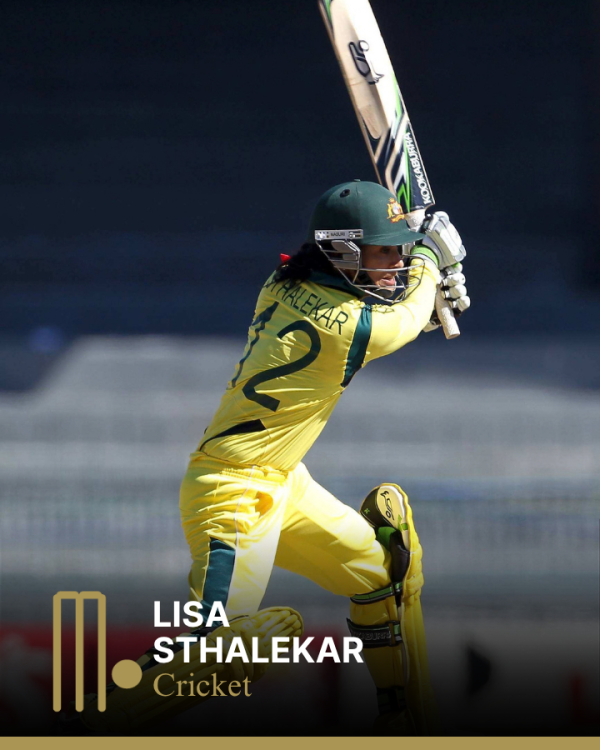
Lisa Sthalekar was inducted into the Sport Australia Hall of Fame in 2026 as an Athlete Member for her contribution to Cricket.
Lisa Sthalekar was a transformational cricketer whose overarching impact on and off the ground helped to shape the direction of the sport.
In a trailblazing career which saw her acknowledged as one of the world’s greatest all-rounders, she would also go on to become one of the leading voices in the game.
Sthalekar’s pride in representing Australia, and her passion for advancing women’s cricket and our dominant place within it became one of this country’s great sporting success stories.
Having been adopted from an orphanage in Pune, India, she came to Australia with her adoptive parents, where her cricket-obsessed father guided her towards the sport that soon became her calling.
She competed – and frequently excelled – against the boys in junior teams before getting her chance in the New South Wales Breakers in the Women’s National Cricket League as a platform towards international representation.
Chosen originally in the open age group as a game-changing off-spinner, she used her subcontinent wrist to open up different areas on the field to become a busy player in the middle to became one of the game’s best all-rounders.
Sthalekar made her one-day international debut in 2001, then played her first Test match against England two years later, scoring a brilliant 120 not out in only her second Test.
Team-wise, she played a key role in the elevation of the Australian women’s team as the world’s best, playing in four World Cup victories – two in the one-day international arena (2005 and 2013) and two in the T20 format (2010 and 2012).
Individually, she was also the first woman to score 1000 runs and take 100 wickets in one-day internationals.
Her last international match for Australia came in the country of her birth, as she took two crucial wickets and took the game-winning catch to help secure the 2013 World Cup trophy.
Sthalekar retired the next day, but her impact on the game has flourished in the years since, having played a significant role as a respected voice and advocate for the sport.
She was inducted into the International Cricket Council’s Hall of Fame in 2020 as a testament to her impact on the sport and the growth of the women’s game across the world.
For all the qualities Lisa Sthalekar displayed as one of the greatest all-rounders in world cricket, it was her competitive edge and unrelenting will to win that drove her to achieve.
She was fiercely determined to always do her best, and willing to do whatever she could to help her teammates rise to the same level, setting her apart from many other competitors.
As Sthalekar explained after her retirement from the international arena in 2013, just a day after helping Australia to a fourth World Cup success with her in the team, winning as part of a collective was always more important than her own admirable individual accomplishments.
“People ask how many wickets did you take, or how many runs did you make, or centuries, and I’ve got no idea?” she explained. “I don’t even know how many games I’ve played for Australia. I’ve never been stats driven.
“I’ve always been a person who just wants to win.”
Her stats were impressive enough.
She was the first woman to score 1000 runs and take 100 wickets in one-day internationals. As one of the best all-rounders in cricket, she excelled in all three forms of the game – playing 125 one-day internationals (taking 146 wickets and scoring 2728 runs), eight Tests (23 wickets and 416 runs) and 54 T20 matches (60 wickets and 769 runs).
But her impact on the teams she played in, and her guiding force as a player, leader, advocate and respected voice for women’s cricket have been every bit as important as her individual qualities as a hard-hitting batter and elite off-spinner.
Her story, too, is one of Australian sport’s most heart-warming success stories.
Sthalekar was adopted from an orphanage in Pune, India, when she was only weeks old, and she was brought up by her adoptive family half a world away in Sydney.
She discovered a passion for cricket through her father, Haren, playing the game in boys’ teams from the age of nine as she honed her skills and her experiences.
In those early years she used to tuck her ponytail into her hat before heading out to play to camouflage the fact she was a girl.
She would later recall: “At my first training (session) I tried to bowl and the ball ended up in the net next to the one I was aiming for – I was bad.”
“But in my first game I took a wicket with my first ball … the guys on my team treated me pretty well and stuck up for me, but some of the other teams were a bit harsh. Still I think those experiences early on really toughened me up as a cricketer.”
Sthalekar broke into the New South Wales Breakers team in the Women’s National Cricket League during the 1997-98 season, predominantly as an off-spinner.
Initially, she took some time to find her feet but worked exceptionally hard on her bowling and just as hard on her batting, which transformed her into an impactful all-rounder.
Her reward came in different forms.
With the Breakers, she went onto a stunning successful domestic career, including five consecutive titles as the captain.
But it was her impact on the international stage that took her from a talented young cricketer into one of the world’s best performers.
She was first selected for the Australian one-day international team in 2001, the first of 125 ODIs she would play for her country.
Two years later, in 2003, she made her Ashes Test debut against England, and in only her second Test she scored an unbeaten 120 in Sydney to help arrest a top-order slide.
It would be her highest Test score, with her best bowling performance coming in 2006, when she took 5-30 to help orchestrate an innings victory over India at Adelaide Oval.
But it was Sthalekar’s versatile impact on the one-day and T20 arena where she truly excelled, with her all-round skills consolidating Australia’s dominance on the world stage.
She was a member of the unbeaten World Cup-winning side in South Africa in 2005, taking eight wickets and scoring 165 runs.
It would be one of four World Cup tournament successes she would have in her career – two in the 50-over format and two in the T20 format.
Sthalekar’s abilities as an attacking middle order player as well as bowler capable of slowing the tempo and stemming the run-rate came to the fore in two T20 World Cup victories in 2010 and 2012.
Her international finale as a player came in the country of her birth, at the 2013 World Cup. She played a key role in securing a final victory over the West Indies where she took two key wickets (2-20 off 10 overs) and claimed the final catch that won the World Cup.
The following day she announced her retirement from international cricket, saying: “To finish my international career by playing in a successful ICC Women’s World Cup in the country of my birth is quite special for me … women’s cricket has changed a lot during my time in the game and it’s been an honour to witness this evolution first hand.”
Sthalekar’s unique cricket career had ended, but not her contribution to the game. She was the first woman elected to the Australian Cricketers’ Association board, as well as the Federation of International Cricketers’ Association, now know as the World Cricketers Association.
Importantly, she fought hard as an advocate and administrator for the rights for women’s cricketers, helping to make the Australian team the highest paid in the world and furthering the game both in her own country and abroad.
In time, she would also become one of the most respected and insightful commentators, impacting on all levels of the game with the same determination and passion she displayed on the field.
She would receive one of the sport’s highest individual honours by being inducted into the ICC Cricket Hall of Fame in 2020.
A year later she was inducted into the Australian Cricket Hall of Fame, with chairman Peter King saying: “Lisa Sthalekar comfortably sits at the table of Women’s cricket trailblazers alongside Belinda Clark, Karen Rolton and Melanie Jones.”
Honours & Achievements
- 2007: Won the Belinda Clark Award as Cricket Australia’s best women’s international cricketer
- 2008: Won the Belinda Clark Award as Cricket Australia’s best women’s international cricketer
- 2008-09: Rated the world’s No.1 all-rounder when the ICC women’s player rankings were introduced
- 2020: Inducted into the ICC Cricket Hall of Fame
- 2021: Inducted into the Australian Cricket Hall of Fame
- 2026: Inducted into the Sport Australia Hall of Fame
Photo courtesy Getty.


