


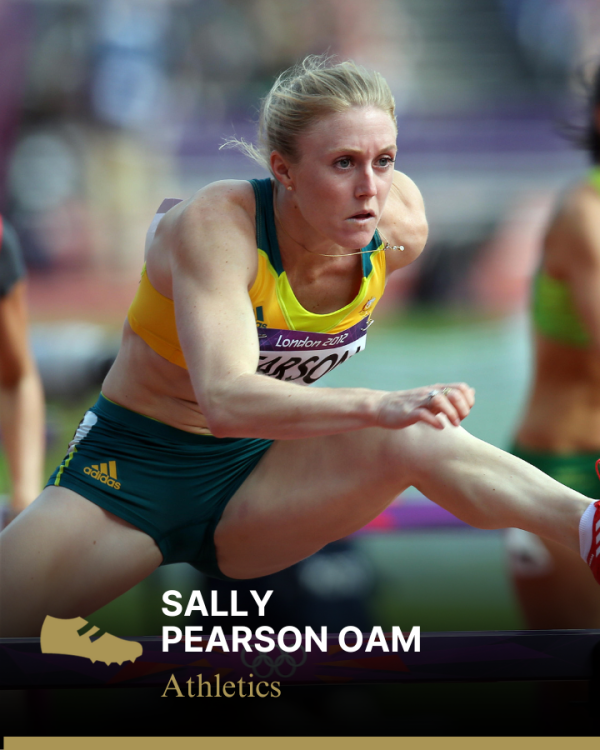
Sally Pearson (nee McLellan) OAM was inducted into the Sport Australia Hall of Fame in 2024 as an Athlete Member for her contribution to the sport of athletics.
Sally Pearson sits among the pantheon of Australia’s greatest female track and field athletes, carrying on the traditions of champions such as Cathy Freeman, Betty Cuthbert, Shirley Strickland and Marjorie Jackson.
She combined a near-flawless technique with a steely resilience which allowed her to overcome a range of obstacles she confronted during her decorated 100m hurdles career.
In achieving Olympic greatness (a gold medal in 2012 and a silver in 2008) and world championship success (gold medals in 2011 and 2017 and a silver medal in 2013), Pearson had been driven by a relentless passion to be the best from an early age.
She often had to do it the hard way. At times she was locked in a battle against her body as much as her opposition.
She stamped herself as a rising star, winning a silver medal at the 2008 Beijing Olympics before turning in a clinically dominant gold medal performance in London four years later.
Her two world championship gold medals came six years apart in different circumstances.
In the first, in 2011, she produced her fastest time – and the sport’s fastest in almost two decades – (12.28 secs) in a blistering performance in Daegu, South Korea.
The second triumph, in London, in 2017, provided her with her proudest individual achievement after overcoming a series of injuries that threatened her career, including a hamstring injury a year earlier which cost her the chance to defend her Olympic title in Rio.
Pearson’s swelling CV included two Commonwealth Games gold medals (2010 and 2014), the first Australian to be named World Athlete of the Year (2011), two Sport Australia Hall of Fame Don awards (2012 and 2014), and a Member of the Order of Australia in 2014.
If an unwavering belief and an unrelenting work ethic are among the elixirs of success, it is not hard to see why Sally Pearson (nee McLellan) reached the pinnacle of her chosen sport.
She didn’t just think she could be the world’s best. She knew she could be.
It was a belief borne not out of brashness, but a fierce competitive instinct and a will to work as hard as anyone else.
As Pearson explained when she drew the curtain on her 100m hurdles career, she had always wanted to be the best in whatever pursuit she undertook.
She excelled at gymnastics and had been introduced by her coach to Gladiators, setting her sights to one day appear on the popular television show.
That never happened, but something even better did.
When she was 11, she took up Little Athletics and flourished, discovering that her athletic talents and competitive spirit provided her with the vehicle to one day reach the pinnacle.
As Pearson once said: “I thought ‘I want to be good at something’. I want to be the best at something. That was my ultimate sporting goal. I had a gut feeling I could be good.”
She didn’t have to look far for inspiration. Her single mum, Anne, worked a number of jobs just to make ends meet, and Sally possessed a similar work ethic, often having to take three buses to get from her school to athletics training.
She first represented Australia in 2003 – as a 16-year-old in a hurry – in the World Youth Championships in Sherbrooke, Canada (winning gold medal in the 100m hurdles) and later that year as a member of the 4x100m relay at the World Championships in Paris, France.
The Gold Coast-based athlete came to the attention of the wider Australian public at the 2006 Melbourne Commonwealth Games, but sadly for the wrong reasons.
In the 100m hurdles final, she stumbled and fell at the penultimate obstacle, before crashing into the last one, explaining later: “It didn’t turn out the way I wanted it to but that’s life – that’s what you get when you get to be a hurdler.”
Refusing to be denied, she went on to help the 4x100m relay team win a bronze medal.
She announced herself on the world stage a month before her 22nd birthday in spectacular fashion. Having reached the final of the 100m hurdle at the 2008 Beijing Olympics, she won the silver medal in a dramatic finish before turning in a heart-warming post-race interview.
“Oh my god, you’ve got to be kidding me, is this real?” she told Pat Welsh.
It was a portent for what was next as she went on to establish herself as one of the world’s best athletes, despite the fact that there were more obstacles ahead.
She aimed for the 100m hurdles and 100m double at the 2010 Commonwealth Games in Delhi, India, and almost got there.
In the 100m final she and England’s Laura Turner recorded false starts, but the officials gave a red card only to Turner as her reaction time was deemed faster.
Pearson competed – and won – before a protest was lodged after the race which saw her disqualified hours later, officially losing the gold medal before it was put around her neck.
She was in tears after the controversial ruling, saying: “The most disappointing part is that I was told I was clear – I did my victory lap with the flag. I was walking out to the medal ceremony and then I was called back. That’s not right.”
Her mental toughness was on show a few nights later when she returned to win gold in the 100m hurdles final.
The setbacks only strengthened her resolve.
She turned in the fastest performance of her career (12.28 secs) – which was then the fourth fastest of all-time – in a devastating burst to win the 100m hurdles world championship gold medal in Daegu, South Korea, storming away to an easy victory.
“I worked so hard to get here,” she said in an interview after the race. “I wanted to win and I wasn’t going to let anything stop me from doing that.”
Such was the merit of her performance that the IAAF named her as the first Australian to be ‘World Athlete of the Year’ in late 2011, alongside Usain Bolt.
She franked that honour by winning the gold medal at the 2012 London Games, in a new Olympic time of 12.39 secs, despite pushing through a nagging back complaint.
A childhood dream had been realised.
Injuries hindered her preparation for the 2013 world championships in Moscow, Russia, but the tenacious Pearson still managed to bring home a silver medal.
She backed up her 2010 Commonwealth Games gold medal with more success in Glasgow, Scotland in 2014, but her 2015 and 2016 seasons were curtailed by injury.
A horrific fall in a competition in Rome in 2015 saw her break her wrist so badly that doctors called it a “bone explosion”. Then, as she prepared to defend her Olympic gold medal the following year in Rio, a hamstring tear at the wrong time again left her on the sidelines.
If it hadn’t been for Pearson’s refusal to concede in a battle against her injuries, that might have been the end of her storied career. But her competitive edge was just too powerful.
In her first major competition in four years, and coaching herself, she stunned the world again by winning the 100m hurdles final at the 2017 world championships in London – a performance she rated as the most satisfying of her career, given what it took to get there.
“I still had something inside me, that’s why I kept going,” she said. “There was this little voice in the back of my head (telling her to keep fighting).”
“For me, that was my proudest moment as an athlete and as a coach, because I was coaching myself.”
It would be a golden exclamation mark on an extraordinary career marked by so many soaring highs and a few frustrating lows, but with a determination almost unmatched in Australian sport.
An attempt to bow out in her hometown 2018 Commonwealth Games on the Gold Coast ended in disappointment due to an Achilles tendon injury, as she reluctantly accepted that her body had given all that it could.
As Australian head track and field coach Craig Hilliard once said of Pearson: “She just finds something … like Cathy Freeman, she finds another 10 per cent when the bar is raised”.
Honours & Achievements
- 2008: Athletics Australia Female Athlete of the Year
- 2011: World Athletics Female Athlete of the Year
- 2012: Athletics Australia Female Athlete of the Year
- 2012: Sport Australia Hall of Fame the Don Award winner
- 2012: Queensland Sports Star of the Year
- 2014: Awarded the Medal of the Order of Australia
- 2014: Sport Australia Hall of Fame the Don Award winner
- 2017: Australian Institute of Sport Female Athlete of the Year
- 2017: Athletics Australia Female Athlete of the Year
Photo courtesy Alamy.


